Introduction: Why First Aid Education for Youth Matters Now
First aid education for youth is one of the most powerful, practical, and life-changing gifts a parent, school, or community can offer a child. Yet across the United States and around the world, millions of children grow up never learning what to do when someone stops breathing, when a wound won’t stop bleeding, or when a friend collapses on the playground.
The consequences of this gap are devastating. In the United States alone, cardiac arrest claims over 350,000 lives outside of hospitals every year and bystander intervention using CPR can double or even triple a person’s chance of survival. When children are not trained, opportunities to save lives are lost every single day.
But first aid education for youth is about far more than emergencies. It builds confidence, develops health literacy, creates community leaders, and lays the foundation for a healthier, more informed generation. This article explores 8 powerful reasons why every child regardless of background or circumstance deserves access to quality first aid training.
At Compassionate HealthEd Foundation (CHF), we believe that knowledge is one of the most compassionate things we can give a young person. First aid education is exactly that knowledge that saves lives.
Reason 1: Children Trained in First Aid for Youth Can Save Lives Including Yours
This is perhaps the most compelling reason of all. Children who receive first aid education for youth are equipped to act in life-threatening emergencies where an adult may not be available or may be the one in need of help.
Consider this scenario: a parent collapses at home from a cardiac emergency. A child with no training panics and freezes, precious minutes passing before help arrives. A child trained in first aid knows to call 911 immediately, begin hands-only CPR, and stay calm until paramedics arrive. That difference is the difference between life and death.
Studies consistently show that early bystander CPR significantly improves survival rates from cardiac arrest. Teaching children these skills means more trained bystanders in every household, school, and community dramatically increasing the chances that someone will act in time when it matters most. The American Heart Association confirms that hands-only CPR can double or triple survival rates when performed immediately.
Reason 2: First Aid Education for Youth Builds Unshakeable Confidence
There is something profound that happens to a child when they realize they have the knowledge and skills to help someone in need. That realization “I can do something” builds a kind of confidence that no classroom exam or sports trophy can replicate.
First aid training places young people in simulated emergency situations where they must think clearly, make decisions quickly, and take action. This process repeated through practice conditions children to respond rather than freeze, to lead rather than follow, and to stay composed under pressure.
This confidence extends far beyond emergencies. Youth who complete first aid education programs consistently report feeling more self-assured in school, more willing to step up in leadership roles, and more capable of handling challenges in everyday life.
Confidence built in a first aid training room carries into every room a young person will ever enter.
Reason 3: First Aid Education Reduces Panic in Emergencies
Panic is one of the greatest threats in any emergency situation. When people panic, they freeze, make poor decisions, or make a bad situation worse. The antidote to panic is preparation and that is exactly what first aid education for youth provides.
Through hands-on, practical training sessions, children learn not just what to do, but how to stay calm while doing it. They practice scenarios repeatedly until the correct responses become almost automatic. This kind of muscle memory is what allows a trained teenager to perform CPR confidently while an untrained adult stands paralyzed with fear.
Research from the International Journal of First Aid Education confirms that children who receive structured first aid training show significantly lower levels of anxiety and panic in simulated emergency scenarios compared to untrained peers.
For communities in Houston and across the United States where medical emergencies can occur far from a hospital having calm, trained young responders in the community is a genuine public health asset.
Reason 4: First Aid Education for Youth Teaches Health Awareness and Prevention
First aid education is not only about reacting to emergencies. A well-designed first aid program for youth also teaches children to recognize the warning signs of illness, understand basic hygiene and sanitation practices, make nutritious food choices, and understand how the body works.
This preventive dimension of first aid education for youth is enormously valuable especially in underserved communities where access to regular medical care is limited. When young people understand what high blood pressure looks like, what dehydration feels like, or what early signs of an allergic reaction mean, they become proactive about their health rather than reactive.
This connects directly to our broader mission at CHF. If you want to understand the full picture of why preventive health matters, read our post on why preventive health education is the future of community wellness.
At CHF, our Summer First Aid Education Program incorporates lessons on nutrition, hygiene, chronic disease prevention, and mental health awareness alongside core first aid techniques because we believe real health education prepares the whole child.
When children understand their bodies, they make better choices for themselves and the people they love.
Reason 5: Youth Trained in First Aid Become Community Health Champions
One of the most remarkable outcomes of first aid education for youth is what happens after the training ends. Children who are trained in first aid do not keep that knowledge to themselves they share it.
They teach their siblings what to do in an emergency. They remind their grandparents to take medication. They recognize when a classmate is in distress and know how to respond. They become, in the most genuine sense, community health champions.
This ripple effect is one of the most cost-effective public health strategies available. By training 40 young people in a community, you are effectively extending health education to the hundreds of family members, neighbors, and community contacts those young people will influence over their lifetime.
Organizations like the American Red Cross have long recognized this multiplier effect, which is why youth first aid and CPR programs are considered a cornerstone of community health strategy across the country. To understand more about how community health workers extend this impact, read our article on how to train community health workers.
Reason 6: First Aid Skills Last a Lifetime
Unlike many things children learn in school, first aid skills once properly taught are retained for life, especially when reinforced through regular refresher training. A child who learns CPR at age 12 and practices it at 15 and 18 carries that skill into adulthood, the workplace, and parenthood.
This long-term return on investment makes first aid education for youth one of the highest-value educational programs any community organization, school, or nonprofit can offer. The cost of training a child today is measured in hours and modest program expenses. The value of that training could be measured in lives saved decades from now.
First aid skills also open professional doors. Many careers from healthcare and education to construction, athletics, and childcare require or prefer employees who hold current first aid and CPR certifications. Teaching children these skills early gives them a professional advantage they will carry throughout their working lives.
Reason 7: First Aid Education Especially Empowers Girls and Underserved Youth
For young girls and youth from underserved communities, first aid education for youth carries additional and deeply meaningful significance. In many communities, girls are not always given opportunities to lead, to be seen as capable, or to develop technical skills that command respect.
First aid training changes that. In a first aid training session, a 13-year-old girl who correctly performs the Heimlich maneuver or leads a group through a CPR scenario is not just learning a skill she is discovering her own capability and authority. That experience reshapes how she sees herself and how others see her.
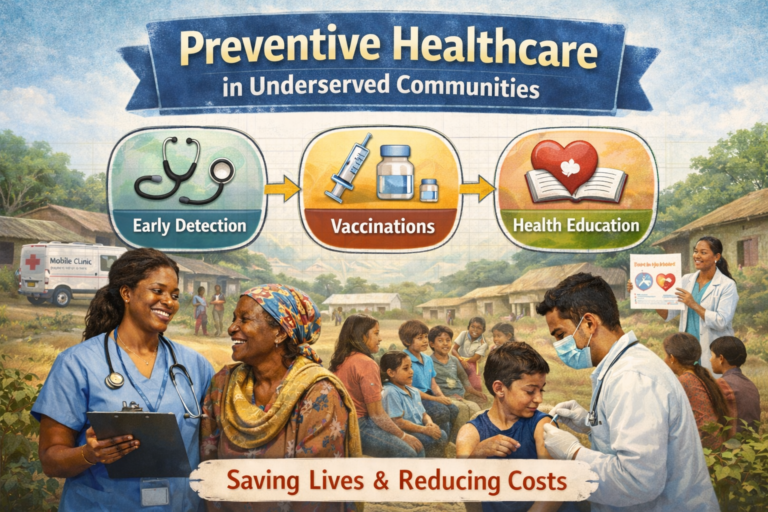
For youth from low-income and immigrant communities communities that CHF proudly serves in Houston first aid education is also an act of equity. These are communities where emergency response times are often longer, where uninsured families are more vulnerable, and where a trained young person can literally bridge the gap between a medical emergency and professional care. Learn more about preventive healthcare in underserved communities and why it matters.
Equipping underserved youth with first aid skills is not just education. It is an act of justice.
Reason 8: First Aid Education Prepares Youth for Real-World Responsibility
We ask a great deal of young people. We expect them to become responsible adults, caring citizens, and capable leaders. Yet we often send them into the world without the most basic practical tools they need to navigate real emergencies.
First aid education for youth fills that gap. It teaches children that responsibility is not just about following rules it is about being prepared to act when others cannot. It teaches them that every person, regardless of age or background, has the capacity to make a difference in a moment of crisis.
These are lessons that shape character. A child who has trained in first aid understands that their actions matter that they can prevent suffering, support recovery, and preserve life. That understanding is the foundation of true civic responsibility.
As communities face increasing challenges zfrom climate-related disasters to public health crises having a generation of young people who are trained, prepared, and confident is not a luxury. It is a necessity. The CDC’s emergency preparedness resources for children highlight just how critical youth preparedness is at a national level.
What Parents Can Do Right Now
If you are a parent, guardian, or community member who wants to ensure the young people in your life have access to first aid education for youth, here are practical steps you can take today:
- Enroll your child in a certified youth first aid or CPR training program in your area.
- Ask your child’s school whether first aid education is part of the curriculum and advocate for it if it is not.
- Practice basic first aid scenarios at home make it a family activity, not just a class.
- Connect with local nonprofit organizations offering free or low-cost first aid training for youth.
- Share this information with other parents, community leaders, and faith communities who can help extend the reach of youth first aid education.
- Start with the basics at home by building 10 preventive health habits that protect your whole family.
How CHF Is Making First Aid Education for Youth Accessible in Houston
At Compassionate HealthEd Foundation Inc. (CHF), we believe that every child regardless of income, background, or zip code deserves access to life-saving first aid education. That is why we are launching our Summer First Aid Education Program for Youth in Houston, Texas, in July 2026.
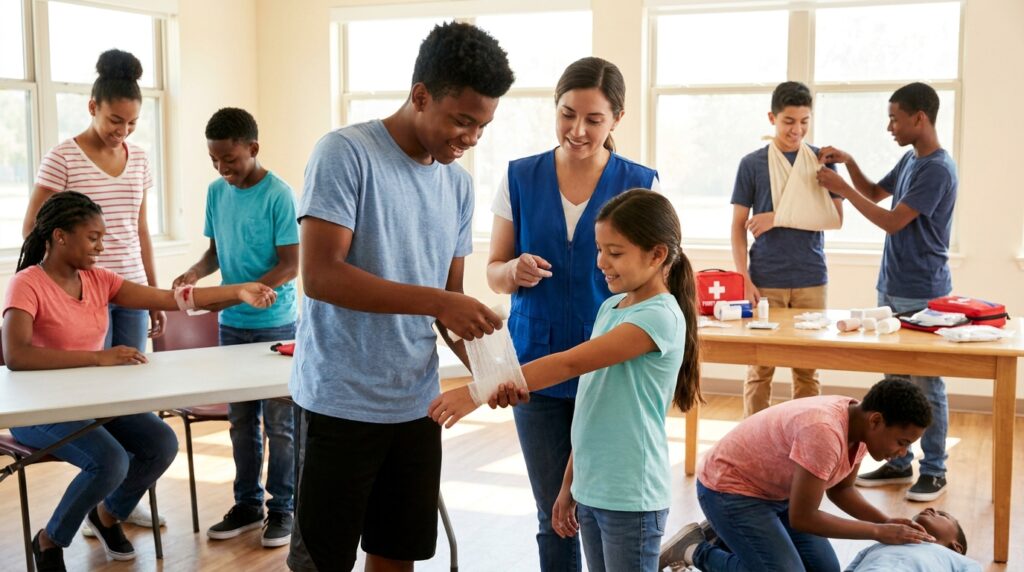
This free, community-based program will provide certified first aid and CPR training to 20–40 young people from underserved Houston communities over eight intensive sessions. Participants will learn how to respond to common emergencies, recognize warning signs of illness, perform CPR, treat wounds and burns, and support someone experiencing a medical crisis.
The program is designed to be accessible offered at no cost to participants, delivered in English and French, and open to youth from all backgrounds. Health education materials will also be available in Pidgin to serve Houston’s West African community.
Applications are open now for Houston youth ages 10–18. Spots are limited. Visit: compassionatehealthed.org/first-aid-application | Email: info@compassionatehealthed.org | Call: +1 (469) 679-8150
Conclusion: The Time for First Aid Education for Youth Is Now
First aid education for youth is not an extracurricular. It is not a luxury. It is a life skill one that every child deserves, and one that every community benefits from when it is made accessible.
The 8 reasons explored in this article make a compelling case: first aid education saves lives, builds confidence, reduces panic, promotes health literacy, creates community champions, lasts a lifetime, empowers the most vulnerable, and prepares young people for genuine civic responsibility.
At CHF, we are committed to making this education a reality for every young person we serve regardless of income, language, or zip code. Because when we invest in the health and knowledge of our youth, we are investing in the future of our entire community.
If this article moved you, share it with a parent, a teacher, a community leader, or a young person who needs to hear it. And if you are in Houston sign your child up today.
About Compassionate HealthEd Foundation Inc. (CHF) CHF is a Houston, Texas-based 501(c)(3) nonprofit organization dedicated to restoring hope through health and knowledge. We serve underserved and immigrant communities through community health outreach, first aid education, women and youth empowerment programs, and humanitarian support. Website: compassionatehealthed.org | First Aid Application: Apply here